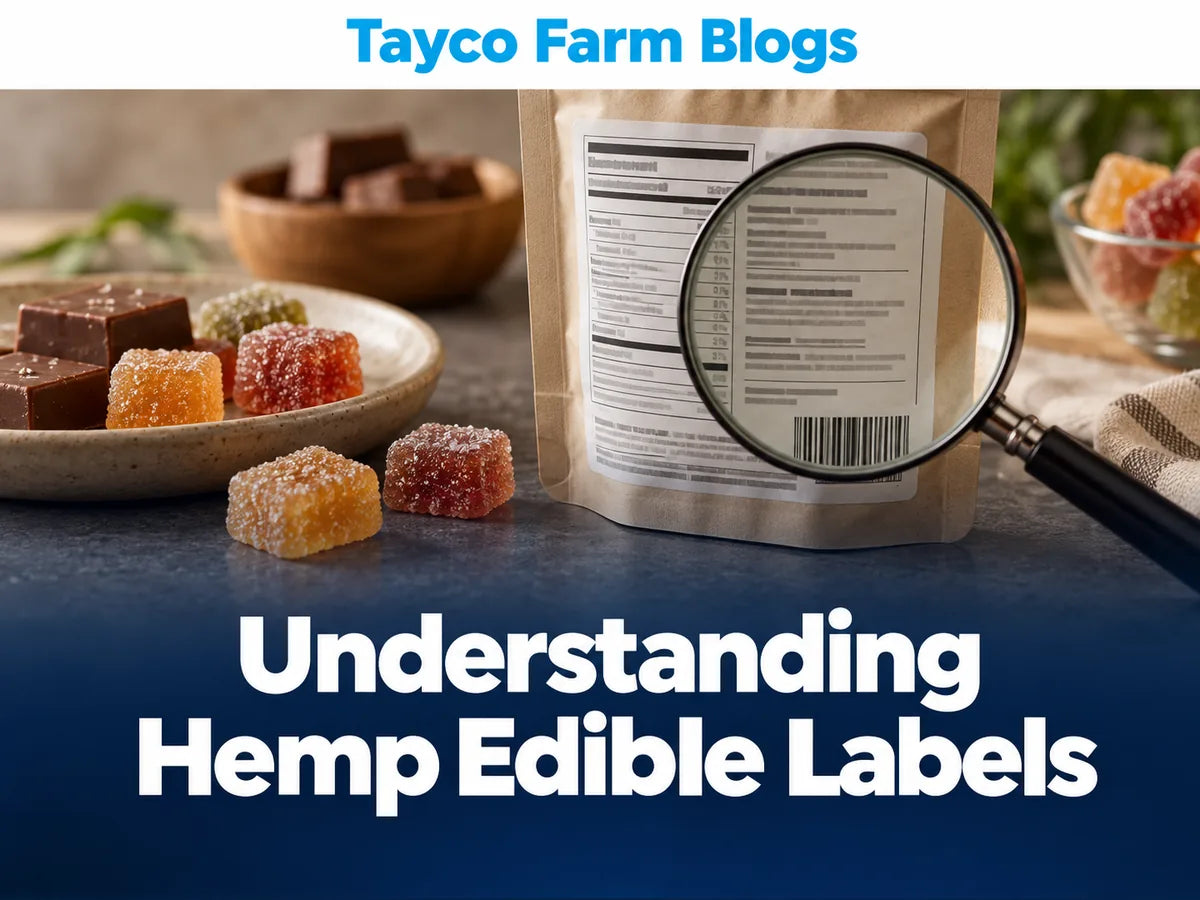
Hemp edible labels often place several different numbers on the same package: the food's net weight, the number of pieces, a serving size and one or more cannabinoid amounts. These figures answer different questions. Reading them together helps explain what the manufacturer is claiming, but a large number on the front does not tell you whether it refers to one piece, one serving or the entire package.
The first task is to identify the substance, the unit and the quantity of food to which the number applies. Then check the ingredient list, batch information and linked laboratory report. This article explains that reading process. It does not recommend a serving amount or treat a label claim as proof of legal status, safety or a particular effect.
Start with what the milligram number actually describes
A milligram is a unit of mass, not a description of an ingredient. “100 mg” is incomplete unless the label states 100 milligrams of what. A number may refer to CBD, delta-9 THC, several cannabinoids added together or the mass of an extract ingredient. Those quantities cannot be substituted for one another. An extract contains more than whichever single compound a reader may have in mind.
Look for the name immediately attached to the number and read any nearby qualification. “Hemp extract” and “total cannabinoids” are not synonyms for CBD. Likewise, a combined total does not reveal how much of each listed cannabinoid is present. When a label provides only an unexplained blend amount, that is an information gap rather than an invitation to assume an equal split.
Piece, serving and package are three different reference points
Reading hemp edible labels without mixing the units
A piece is a physical item, such as one square or one gummy. A serving is the quantity defined on the relevant label panel, which may be one piece, several pieces or a portion of a larger item. The package is the entire retail container. A statement attached to one reference point should not be silently transferred to another.
Consider a fictional package containing 12 pieces, with a label that defines three pieces as one serving. That package contains four labeled servings, not 12. This is a counting example, not a recommendation to consume three pieces. It illustrates why a familiar-looking food shape cannot tell a reader the manufacturer's serving definition.
| Label term | What to identify | Common reading error |
|---|---|---|
| Per piece | The individual item described | Assuming one piece equals one serving |
| Per serving | The stated serving size | Ignoring that a serving includes multiple pieces |
| Per package | The entire container | Reading the package total as a piece amount |
| Net weight | Total mass of the food | Treating food weight as cannabinoid weight |
Net weight does not describe cannabinoid content
The net weight includes the finished food: sugars, fats, water, gelling agents, flavorings and other ingredients. It is normally far larger than the mass of an individual cannabinoid. A statement in grams on the principal display panel may therefore be a required food quantity declaration rather than a potency statement. The unit alone does not identify what is being measured.
This distinction also matters when reading laboratory results. A report may express a cannabinoid as a percentage of sample mass or as milligrams per gram. Those are concentrations. A retail label may instead report an amount per piece or per package. Comparing them requires the correct sample weight and a clear understanding of the report's basis; matching the printed numbers visually is not enough.
Read the ingredient list separately from the cannabinoid panel
The ingredient list describes the food formulation. It can identify a gelatin or pectin base, dairy ingredients, oils, colors, coatings and compound ingredients with their own subingredients. A flavor name on the front is not a reliable summary of this information. A fruit-flavored product can contain animal-derived ingredients, while a chocolate product can contain fillings that introduce additional allergens.
For conventional foods, FDA labeling guidance explains ingredient and major-allergen declarations. Hemp branding does not remove those food-label questions. Read the actual ingredient panel each time a formulation changes, and distinguish a missing ingredient from an unsupported assumption. The absence of a front-label warning is not evidence that every relevant question has been answered.
Match the batch before relying on a laboratory report
A QR code or web link is a route to information, not the information itself. Open it and identify the report's sample name, batch or lot number, report date and laboratory. Then compare those details with the package. A generic page containing several reports requires another step: selecting the one connected to the actual item.
Check whether the tested material was a finished edible or an ingredient used to make it. A bulk extract result cannot, by itself, demonstrate the distribution of that ingredient through every finished piece. Also inspect the panels included. A cannabinoid table does not imply that residual solvents, pesticides, metals or microbiological hazards were all assessed on the same report.
Understand the limits of arithmetic
Dividing a package total by a piece count gives a mathematical average under the assumptions that the count is correct and the material is evenly distributed. It does not measure an individual piece. A batch test has its own sampling design, and the result may describe a composite sample rather than separately tested units. Those distinctions are especially relevant when a label uses precise-looking decimal places.
Arithmetic is still useful for spotting contradictions. If the per-serving amount, serving count and package total cannot be reconciled on the same basis, ask the manufacturer to explain the discrepancy. Do not invent a missing unit, round away a substantial mismatch or assume that the largest number is the most authoritative one.
Label literacy is separate from legal approval
A clear label can explain a manufacturer's claim without establishing that the product may lawfully be marketed in a particular place. Federal food law, federal hemp definitions and state requirements are separate parts of that analysis. FDA distinguishes certain hemp-seed food ingredients from foods with added CBD or THC. A familiar food format does not settle that distinction.
The same separation applies to medical language. An ingredient amount, a laboratory result or a serving statement does not establish treatment benefits. Educational reading should stay with what the document actually supports: identity, stated quantity, ingredients, traceability and the scope of testing. Those are useful facts without attaching promises about how a person will feel.
A practical order for reading the package
Begin with the named substance and its unit, identify whether the amount is per piece, serving or package, and locate the serving definition. Read ingredients and allergens next, then connect the batch to the appropriate report. Finally, check storage instructions and the manufacturer's contact details. For a closer look at the report itself, see our hemp COA explainer.