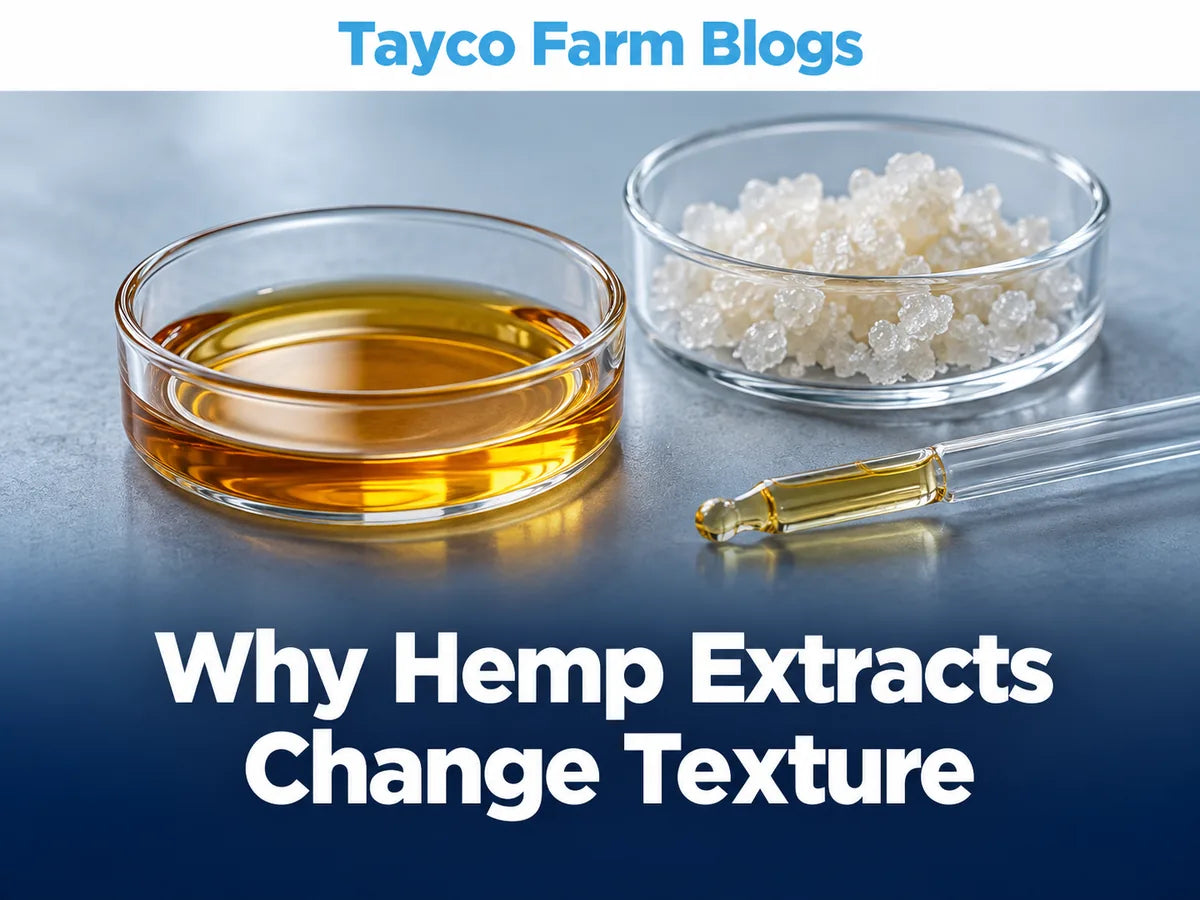
Hemp extract texture can change because an extract is a mixture, not a single uniform substance. Cannabinoids, aromatic compounds, plant waxes and any added carrier oil can behave differently as the product sits. Crystals, cloudiness and layers therefore describe different physical changes. None of those appearances, by itself, establishes potency, contamination or whether a particular product is suitable to use.
The useful question is what changed, in which formulation, and under what conditions. A clear oil that develops particles needs a different explanation from a water-based emulsion that separates into layers. Understanding that distinction makes it easier to describe a problem accurately, interpret a laboratory report and avoid treating appearance as a substitute for evidence.
Why an extract does not always stay visually uniform
A compound may be dissolved in a liquid even though it would be solid on its own. Whether it stays dissolved depends on the compound, the surrounding liquid, concentration and temperature. A formulation that looks clear at one point can develop visible solids later if those conditions change. The entire mixture does not have to become solid for crystals to appear.
Other products contain materials dispersed through a liquid rather than fully dissolved in it. These may include very small droplets or suspended particles. They can scatter light, giving a cloudy appearance, or gradually collect into a separate region. That is a different process from a dissolved substance arranging into a crystal. Calling every change “crystallization” can obscure the actual issue.
Crystals, cloudiness and separation are different observations
Describing hemp extract texture without guessing its cause
Crystals often have a recognizable solid form, although small crystals may initially resemble haze or sediment. Cloudiness is a broader description: it simply means light is not passing through the sample as clearly as before. Separation describes distinct regions or layers. A photograph can document these observations, but it cannot identify the chemical composition of an unknown particle or layer.
| Observation | Possible physical explanation | What it does not establish |
|---|---|---|
| Visible crystals | A component has come out of solution | The identity or purity of that component |
| Haze or cloudiness | Fine particles or dispersed droplets scatter light | Whether the product is contaminated |
| Distinct layers | Components are no longer evenly distributed | The concentration in either layer |
| Thicker or thinner flow | Temperature or composition affects viscosity | A higher or lower cannabinoid amount |
What crystallization research can actually tell us
Published research has documented CBD crystallization from cannabinoid-rich mixtures. That supports a limited but useful point: a cannabinoid can form crystals under particular physical conditions. It does not mean every crystal in every hemp product is CBD, and it does not turn a household inspection into a chemical identification method. A formulated tincture, an undiluted extract and a confection are different materials.
Laboratory studies also control conditions that a consumer usually cannot reconstruct. The original formulation, storage history and identity of the solid may all be unknown. A responsible explanation therefore separates a plausible mechanism from a confirmed diagnosis. A manufacturer can compare the observation with its formulation specifications; an appropriate laboratory can investigate composition when needed.
Temperature can affect flow without proving degradation
Many oils flow more slowly when cool and more readily when warm. A change in thickness can therefore be a physical response rather than evidence that the cannabinoid content has changed. At the same time, prolonged exposure to unsuitable conditions can affect a product in other ways. The visible response and the chemical response do not necessarily happen together or at the same rate.
This is why a general internet instruction to heat, freeze or otherwise “fix” an extract is unreliable. Packaging, seals, carrier ingredients and the manufacturer's stability information all matter. Follow the storage directions for the finished product, and ask the manufacturer about an unexpected change. Improvised treatment can make the original problem harder to assess and may introduce a new one.
Carrier oils and emulsions change the interpretation
An extract mixed with a carrier oil is not physically identical to the original extract. The carrier becomes part of the system that keeps components dissolved or dispersed. A water-containing formulation adds another set of considerations because oil and water do not automatically remain evenly mixed. Ingredient lists can help identify the type of formulation, although they rarely provide enough detail to diagnose its stability.
For example, a label listing a carrier oil and hemp extract suggests a different starting point from a product listing water, emulsifiers and several food ingredients. Neither ingredient list proves that a visible change is expected. It does, however, explain why one storage or handling instruction cannot sensibly apply to all products that happen to contain hemp.
What to document before contacting the manufacturer
Keep the original container and record the product name, batch number and any printed date. Photograph the product in ordinary light without filters, including the entire container and a closer view of the change. Note when you first noticed it, whether the seal was intact and whether the package experienced unusual heat, cold or leakage. Those details are more useful than describing the product as simply “bad” or “strong.”
Ask whether the appearance falls within the manufacturer's specification for that exact formulation and batch. If the answer refers to a laboratory report, check that the report matches the batch and the type of material. A potency report for a bulk ingredient does not automatically explain a change in a finished bottle. Avoid assuming that stirring or shaking resolves a question about identity or contamination.
Texture cannot replace a certificate of analysis
A certificate of analysis, or COA, reports results for a submitted sample and the tests performed on it. Its value depends on sample identity, methods, reporting limits and the connection to the product in question. A cannabinoid panel addresses composition within its scope; it does not automatically include every contaminant panel or investigate a visible defect. “Lab tested” is too broad to answer those separate questions.
For the structure of a report, see our guide to reading a hemp COA. Use the report alongside the batch information and the manufacturer's response. The goal is to connect observations to evidence, rather than assigning a quality grade from how an oil looks in a photograph.
A useful explanation has limits
Crystallization, cloudiness and separation can all have ordinary physical explanations, but an ordinary explanation is not the same as a verified explanation for a particular container. Unexpected changes, damaged packaging or an uncertain storage history warrant clarification before further use. Do not taste an unknown change to investigate it. Good product education explains what an observation may mean while remaining clear about what only documentation or testing can establish.