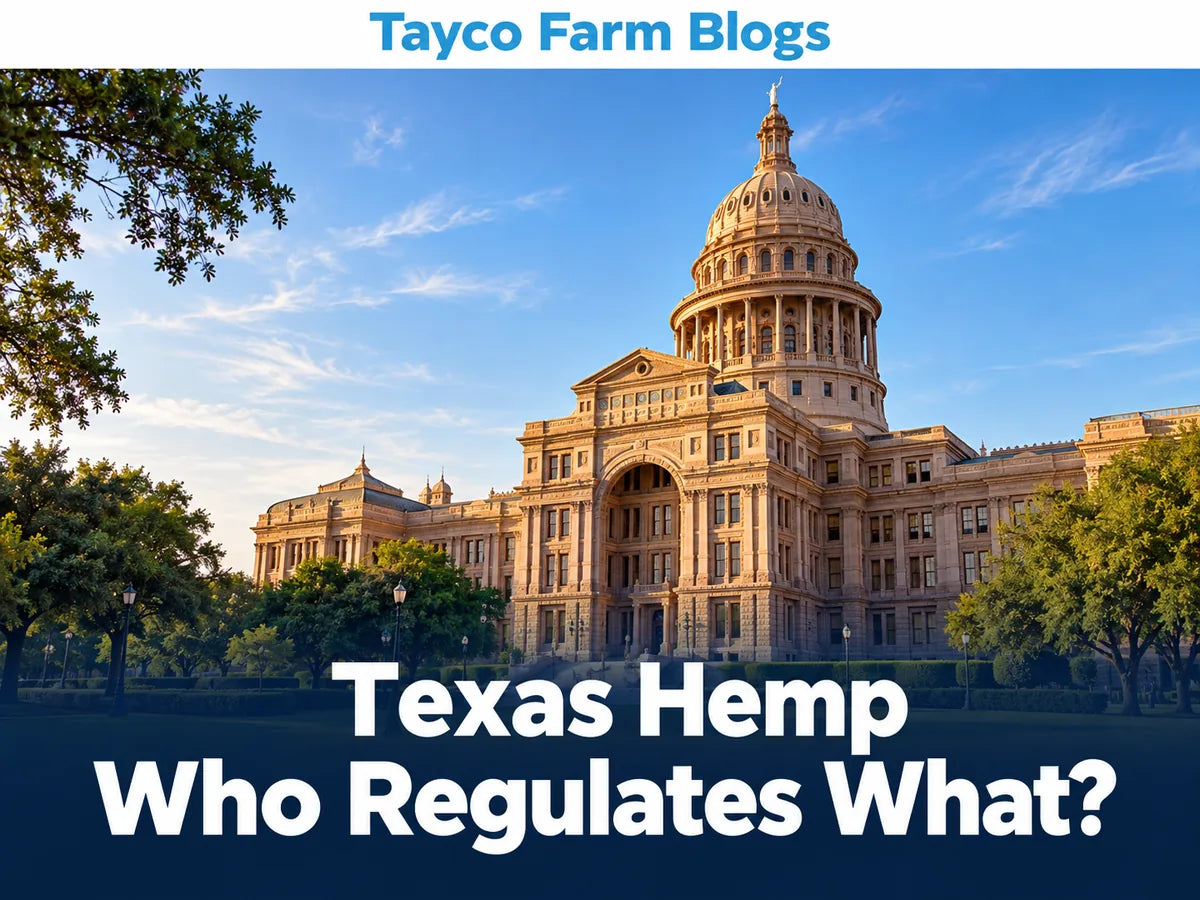
Texas hemp regulation involves several agencies because growing a crop, manufacturing a consumable product, labeling food and enforcing controlled-substance law are different activities. A Texas Department of Agriculture license answers a different question from a Texas Department of State Health Services registration. Neither should be read as a universal approval of every product a business handles.
Understanding those responsibilities is more useful than looking for one agency that makes an item “legal.” The relevant question is which activity, material and rule are involved. This guide maps the main responsibilities and explains how to find the appropriate official source when headlines or marketing language collapse several distinct requirements into one claim.
Legal source review: October 21, 2026. This is an educational overview of agency roles, not a determination about a particular product. Rules, effective dates and court orders can change; use the official links below to check the status relevant to your question.
TDA handles the agricultural side of the framework
The Texas Department of Agriculture, usually abbreviated TDA, administers the state's hemp production program. Its materials address agricultural licensing and the framework for producing hemp under the state plan. This is where questions about the production program belong. It is not the same program as the one governing consumable hemp product manufacturers and retailers.
A crop-related document has a defined purpose and scope. It should not be treated as a laboratory result for a finished edible or as permission to make a food claim. Materials can pass through several stages between a field and a finished package, and each stage can raise different obligations. The document that is relevant at the farm may not answer the question at the retail shelf.
DSHS administers the consumable hemp program
The Texas Department of State Health Services, or DSHS, publishes the state's consumable hemp program information. Its resources address licensing and registration, product requirements, labeling and applicable rules. For a consumer trying to understand a batch code or a manufacturer trying to locate the current consumable-product rules, DSHS is a primary starting point.
Registration is not a substitute for examining an individual product. A business credential, a package label and a laboratory report are different types of evidence. They may all be relevant, but each supports a narrower proposition than “everything associated with this business is approved.” Read the credential's scope and the rule that gives it meaning.
Texas hemp regulation by activity
| Question | Primary starting point | Important distinction |
|---|---|---|
| Texas hemp production program | TDA | Agricultural authorization is not finished-food approval |
| Texas consumable hemp requirements | DSHS | Business credentials and product compliance are separate |
| Federal hemp production framework | USDA | Production testing is not a complete retail-product assessment |
| Federal food and product claims | FDA | Hemp status does not erase food-law requirements |
USDA's role concerns hemp production
The United States Department of Agriculture administers the federal domestic hemp production framework, including oversight of approved state and tribal plans. Its guidance explains production sampling and testing concepts. Those materials are valuable for understanding why a crop test considers the relationship between delta-9 THC and THCA, rather than relying on a casual reading of one isolated number.
The object being tested matters. A crop sample and a finished confection are not interchangeable samples, and they are not necessarily assessed under the same program. A statement that an agricultural lot met a production requirement should therefore retain that context. It cannot automatically be carried forward as a finding about every downstream ingredient or packaged item.
FDA asks separate food-law questions
The Food and Drug Administration regulates categories such as food, dietary supplements, drugs and cosmetics under federal law. Its cannabis guidance distinguishes hemp's controlled-substance classification from whether an ingredient may be added to a food or marketed in a particular category. This is why “hemp-derived” is not a complete federal regulatory explanation for an edible.
FDA has also addressed certain hemp-seed ingredients separately from CBD and THC. The plant source alone does not make those ingredients legally or chemically equivalent. When reading an agency statement, identify the exact ingredient and intended use. A statement about hulled hemp seed should not be presented as approval of an unrelated cannabinoid formulation.
Courts and controlled-substance decisions can affect the picture
Agency pages sometimes describe a rule alongside litigation about whether it may be enforced. A court order may pause enforcement temporarily, reverse an earlier order or address only a defined issue. Its effect depends on the actual order, the parties and the procedural stage. A headline saying a restriction was “blocked” does not explain all of those details.
For example, the current DSHS program page discusses the Texas Supreme Court's decision in the Sky Marketing litigation and the July 31, 2026 scheduling action concerning delta-8 THC. That is a specific development, not a blanket finding that every other cannabinoid or product format is permitted. The official notice and the underlying decision must be read within their own scope.
How to route a real question to the right source
Write the question in concrete terms before searching. “Which document explains a retail label's batch-code requirement?” points toward DSHS. “What does the production program require from an agricultural license holder?” points toward TDA and the relevant production plan. “Does a federal hemp definition authorize CBD as a food ingredient?” requires FDA materials as well as the statute defining hemp.
Then record the source date and the type of document. A program FAQ can explain a process, but the adopted rule or statute supplies the underlying legal text. If a page links to litigation updates, follow those links before treating the FAQ as a complete current answer. Save the exact provision that supports the conclusion, rather than only the agency homepage.
Why one certificate cannot answer every question
A laboratory certificate addresses the tested sample and listed analyses. A license addresses the holder and the authorized activity. A label communicates product information and claims. None is interchangeable with a court order or a statutory definition. Keeping these documents separate makes it easier to identify what is established and what remains unresolved.
For label-specific questions, the DSHS labeling page is a useful next step. For testing terminology, our COA explainer describes how to read a report's scope. Neither should replace a current review of the applicable law when an actual compliance decision is involved.